




She had the clients. Her brand didn’t match them.
Sloane Carrington had spent over a decade inside the rooms where real decisions get made. As a former corporate operator-turned-advisor, she’d built her reputation entirely through the quality of her work and the depth of her relationships. Referrals came steadily. Clients were high-caliber. Results were real.
But her business had outgrown its own infrastructure.
The founders she was now advising were navigating $5M–$25M growth transitions. These were inflection points defined by decision fatigue, strategic isolation, and the psychological weight of leading at scale. They were looking for a thinking partner with the precision and authority to meet them where they operated.
Sloane’s brand wasn’t communicating that because the architecture wasn’t there.
As demand for her advisory work increased and her thought leadership expanded (a podcast, speaking engagements, and a growing platform) the gap between how Sloane showed up offline and how she was positioned online became harder to ignore. She was ready to stop underrepresenting herself.
Beyond aesthetics: It was a structural issue
The instinct when a website isn’t converting is to just fix how it looks. That would have been the wrong move here.
Sloane’s brand had design polish but it was architecture underneath that needed more work. The kind of work that earns trust before a prospect ever reaches a call, pre-qualifies without being exclusionary, and communicates value in a way that’s proportional to a $20,000+ investment decision.
Specifically, the gaps were:
- Messaging lacked hierarchy: no clear flagship, no offer escalation, no named intellectual property to anchor authority
- Authority was implied rather than framed: her depth of experience was present but never synthesized into a positioning signal
- No “why now” tension: the site was informational, not urgent, with nothing structuring the reader’s decision-making
- Multiple services existed without a clear tier structure: prospects had no guided path, which diluted perceived value across the board
- No named IP: her framework existed in practice, but hadn’t been formalized into an asset that could carry weight in the market
The result was a brand that made a strong referral client feel comfortable, but couldn’t do the heavy lifting of attracting cold, high-trust prospects independently.
That’s what we set out to change.
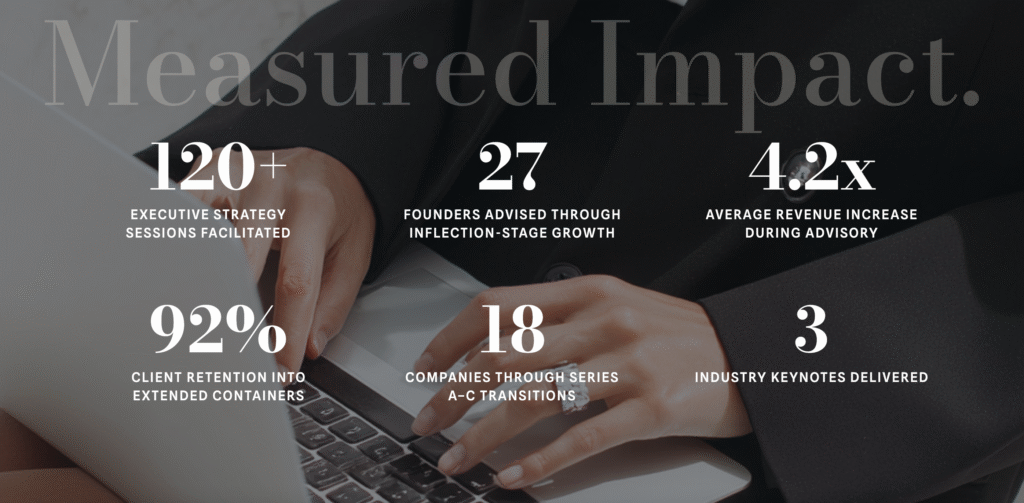
Engineering authority
The work fell into four interconnected areas. Each one was strategic and nothing was cosmetic for its own sake.
A. Authority Framing
Sloane’s work already had a distinct methodology: a way of assessing and recalibrating founder capacity that went beyond mindset and touched decision architecture, identity at scale, and leadership stamina. The problem was it had no name.
Introducing The Authority Index™ as named IP did several things simultaneously: it gave the flagship container a handle that felt measurable and outcomes-oriented, it created a proprietary framework that couldn’t be commoditized, and it shifted the positioning from “executive coach” (a crowded and often dismissed category) to “strategic operator for founders entering their next tier.”
Language across the site shifted accordingly. Consultant language gave way to strategic operator language. The transformation promised wasn’t internal growth. It was structural recalibration.
B. Offer Ladder Architecture
High-ticket containers require a trust escalation path. Cold prospects at $20,000–$30,000 need a lower-friction entry point to earn the relationship.
We built a three-tier ecosystem:
- Founder Capacity Audit: a diagnostic entry point positioned as the first step
- Executive Recalibration Intensive: mid-tier container for targeted, time-bound engagements
- The Authority Index™: the six-month flagship, visually and hierarchically elevated above everything else
This structure created clarity for the prospect (“where do I start?”) while also demonstrating that Sloane thought in systems, a quality her target clients require in their advisors.
C. Psychological Hierarchy on the Page
The sales page was built around a specific psychological sequence: establish the weight of the problem before introducing the solution. High-growth founders respond to precision; the feeling that someone understands the exact texture of what they’re carrying.
The hero didn’t explain the offer. It named the moment: the point where growth stops being energizing and starts creating complexity that compounds faster than it can be managed. The solution arrived only after that tension was fully established.
Scarcity was structural, not performative. We communicated limited availability through intake language and selective positioning rather than countdown timers.
D. Visual Direction
The visual system was built to communicate controlled power. Not warmth. Not approachability. Authority with restraint.
- Color palette: deep navy (#11161C) as the foundation, burnt brick (#8C3A2E) as the elevated signal for The Authority Index™, crimson (#7C1F2A) for CTAs — all muted, none bright
- Typography: Bodoni Moda for headlines (authority, intellect, controlled femininity), Spline Sans for body (precision, clarity)
- Design motif: the city as metaphor — vertical lines echoing skyscrapers, layered imagery, cropped frames implying control, subtle motion creating the feeling of elevation
The hero section was designed with intentional kinetic energy. It was a layered, multi-image composition that moves in a way that mirrors the environment Sloane’s clients actually operate in: fast-moving, high-stakes, visually complex. The kind of pace where decisions compound before the last one is finished.
Rather than a static founder portrait and a headline, the hero feels like entering a city mid-stride. Images layer and shift. The eye moves. The headline lands against that motion as a point of stillness which is exactly what Sloane offers her clients.
That contrast: kinetic environment, precise anchor does strategic work. It signals to the founder scrolling at 11pm between back-to-back decisions that this is a brand that understands their world. It doesn’t ask them to slow down. It meets them where they are.

The brand started doing the work.
The goal of this project was to close the gap between the caliber of work Sloane was already doing and how that work was represented online.
The site is structured to produce these shifts:
- Discovery conversations change character: prospects arrive already oriented, already self-qualified, already using the right language to describe what they need
- The referral dynamic shifts: the site becomes something worth sending, not just something that exists
- The brand starts filtering without the founder having to do it manually in every intake call
- Cold traffic (from a podcast, a keynote, a LinkedIn post) has somewhere credible to land
Those are the structural outcomes this type of project is designed to create. Not a spike in traffic. Not a viral moment. A brand presence that works proportionately to the investment being asked of the people it’s trying to reach.
For a container priced at $18,000–$30,000, the site has one job: make the right person feel certain. Everything in this project was built toward that.
“The goal of every project like this is simple: the brand should feel proportionate to the work. That’s what we built.”

Strategic Brand Architecture
Sloane Carrington’s finished website demonstrates strategic brand architecture. The visual system mattered, but it mattered because of what it communicated, not how it looked in isolation.
For founders and advisors at this level, a website has one core job: to make the right person feel certain, and to make the wrong person feel like this isn’t for them. That kind of precision requires:
- Understanding premium buyer psychology: how trust is built at a $20,000+ price point, and what breaks it
- The ability to translate expertise into named intellectual property: so the work becomes a brand asset, not just a service
- Offer architecture that guides so the prospect’s path is clear without being prescriptive
- Visual systems that signal: where every color choice, font pairing, and layout decision earns its place
- Copywriting precision that earns authority on the page, before anyone gets on a call
The work I do sits at the intersection of strategy, messaging, and design because a website built at the level this audience operates on can’t afford to be excellent in just one of those areas.


